What Is Chinese Bone-Setting? Hong Kong's Hidden Healing Art
Key takeaways:
- Chinese bone-setting (tit tar) (跌打) is a manual therapy tradition within Chinese medicine, used mainly for sprains, joint and soft-tissue problems.
- In Hong Kong it is not an unregulated back-street trade: practitioners are registered with the Chinese Medicine Council of Hong Kong under the Chinese Medicine Ordinance.
- A responsible first visit starts with assessment, not manipulation. Suspected fractures or acute trauma belong in a hospital, not a bone-setting clinic.
- You can verify any practitioner in about two minutes on the Council's public register.
- This website does not list fees. Results vary from person to person.
Walk around Jordan or Yau Ma Tei at night and you will spot shopfront signs reading 跌打 — literally "fall and hit". This is bone-setting, a manual therapy tradition Hong Kong families have used for generations for sprains, stiff necks and minor injuries. Visitors often walk past without realising these are clinics, not massage parlours. This guide explains what bone-setting is, how Hong Kong regulates it, and what to expect — with the verification steps included so you can check everything yourself.
What bone-setting actually is
Bone-setting (正骨 / 跌打) is the manual-therapy branch of Chinese medicine: hands-on techniques for joint misalignment, soft-tissue injury and restricted movement, often combined with acupuncture or external herbal poultices. Bone-setting is distinct from both Western chiropractic and physiotherapy, even though all three sometimes treat the same painful shoulder. For background on the tradition, see the Wikipedia entry.
People typically come in for a twisted ankle from a hiking trail, a neck that locked up after a long flight, or a shoulder stiff for months. We compared bone-setting and chiropractic in detail in an earlier article; this one is the introduction for readers who have never heard of the practice at all.
How Hong Kong regulates bone-setting (and how to verify a practitioner)
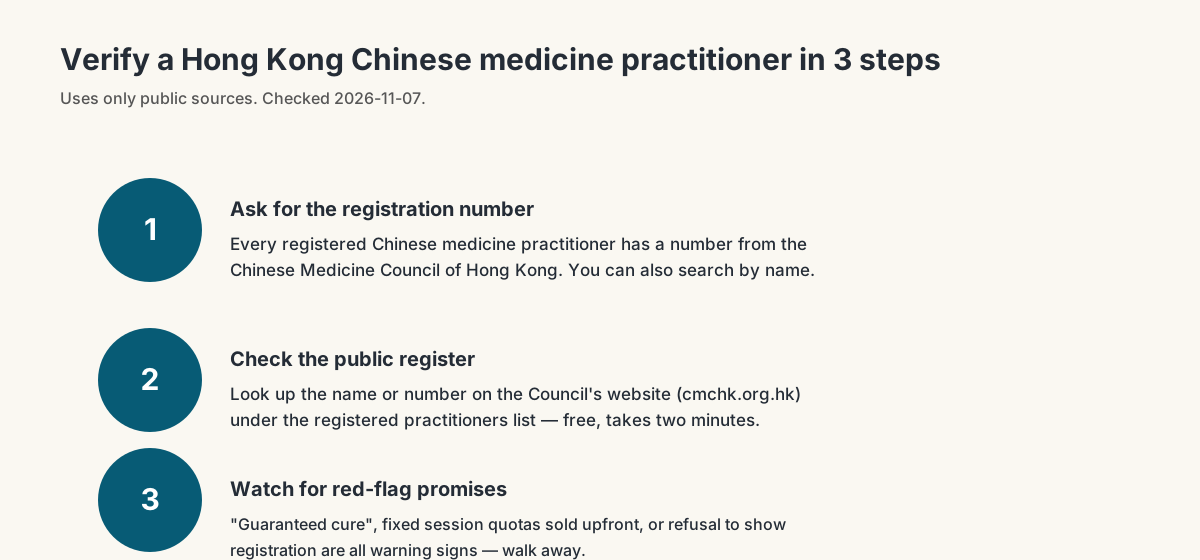
Hong Kong is one of the few places where this tradition sits inside a formal regulatory system. Under the Chinese Medicine Ordinance, anyone practising Chinese medicine — including bone-setting — must register with the Chinese Medicine Council of Hong Kong, and the register is public.
That gives you a simple safety check: ask "Are you a registered Chinese medicine practitioner?" and "What is your registration number?", then look the number up on the Council's website. You can search the register by practitioner name. Anyone who hesitates or says registration "doesn't matter" is telling you something important.
| Well-run clinic | Warning sign |
|---|---|
| Registration number volunteered and verifiable | Credentials vague or "too busy to show" |
| Assessment and questions before any hands-on work | Manipulation starts within minutes, no history taken |
| Fees explained clearly on enquiry | Large prepaid packages pushed before any assessment |
| Clear advice on what they cannot treat, and when to see a doctor | "Guaranteed cure" or promises of a fixed number of sessions to "fix" you |
What a first bone-setting session looks like
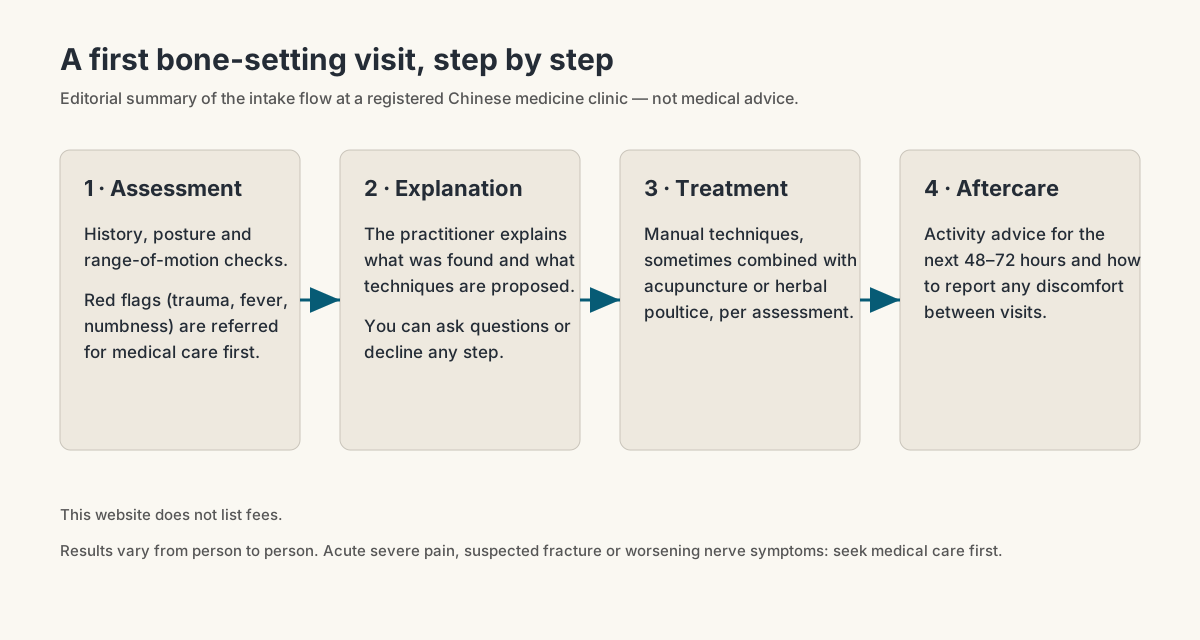
A responsible first visit is slower than people expect. At our clinic it runs in four stages: assessment (history, posture, range of motion), explanation of what was found, the treatment itself, and aftercare advice for the next two or three days. If anything suggests a fracture, acute inflammation or worsening nerve symptoms, the correct next step is a hospital — not a treatment table. Any practitioner who doesn't say so is not doing their job.
Language is rarely a barrier in tourist districts. If you are unsure, ask the clinic before your visit.
What bone-setting can and cannot do
Honest boundaries matter more than promises. Bone-setting is commonly sought for sprains, postural neck and back discomfort and recovery support after minor soft-tissue injuries. It is not a substitute for emergency care, imaging, or treatment of fractures, infections or systemic disease. Results vary from person to person, and nobody legitimate will guarantee an outcome or a fixed session count in advance.
With a travel injury, the practical order is: severe pain, deformity or inability to bear weight → hospital first. Lingering stiffness or an old sprain that never quite settled → that is where a registered practitioner can assess you properly.
References and common questions
Practitioner registration and public register: Chinese Medicine Council of Hong Kong. Background on the bone-setting tradition: Wikipedia: Dit da. General back-pain guidance for comparison: NHS: Back pain. This article is health-education content written by our practitioner; it is not a diagnosis and does not replace an in-person consultation.
Is bone-setting painful?
Most techniques feel like firm pressure or a quick, controlled movement. Mild soreness for a day or two afterwards is common and should fade; pain that worsens, spreads, or comes with numbness or weakness is not a normal reaction and should be checked by a doctor.
Do I need to speak Cantonese?
Language is rarely a barrier in tourist districts. At Kwong Tai (11 Pine Tree Hill Road, Jordan, Kowloon, open daily 09:00–21:00) we regularly explain each step before doing it.
How much does it cost?
This website does not list fees.
How do I verify a practitioner?
Ask for the registration number, then check it on the Chinese Medicine Council of Hong Kong's public register (cmchk.org.hk). Two minutes of checking is basic self-protection.
More from the clinic
Bone-Setting vs Chiropractic: What's the Difference? (2026-10-29) — both work on joints and spine, but the two traditions are regulated under different systems in Hong Kong.
Jet Lag Recovery the Chinese Way: Acupuncture in Jordan, Hong Kong (2026-10-23) — what travellers ask us about most.